Friday, April 16, 2010

Plastic bottles... where do you go?

This week I made it to the rubbish dump in search of plastic recycling. To get there Sarah (thanks to her knowledge of truffi’s) escorted me to the right neighbourhood. Well, her and the help of the person next to me on the truffi. The older Cochabambino gave me great directions and instructed the truffi driver on where to drop me off. For this I was thankful because getting to the dump did not end up being as straight forward as I would have liked. I had to hunt for a bridge to cross the river and speak with a local woman who was not convinced I really wanted to know where K’ara K’ara was. In the end this trip was experiential rather than educational in the pedagogic sense. It blended two disparate beasts: adventure and the confronting reality of poverty.


After crossing the small bridge (stolen from The Temple of Doom archives) I wandered up a peaceful hill on a winding dirt road toward (I assumed) the dump. Despite the depressed nature of the neighbourhood there was a calm here that was surprisingly comforting. Comforting until I made it half way up the hill. As I came to the fourth bend I could hear dogs barking. When I appeared around the corner a group of dogs on my right raced toward me barking and bearing their teeth while another group barked and circled to my left. When I walked on they all slowed but continued to aggress. This was the cue to shit my pants. My pace began to halt and then a lady emerged from doing her washing. The lead dog of the left pack turned its head toward her with doe-eyes. Then stopped barking. All the dogs on the left quietened and I was able to pass while the dogs on the right continued the vocal assault.

After the dogs I hardly minded the irritated expression the lady at the top of the hill gave me when I asked for directions. Unfortunately for me the dump ended being visible from where we were both standing. As I approached there was little smell coming from the dump. They must be doing something right. At the fence line I found a sign that says there is a 1000 Boliviano fine for trespassing. I would not be seeing the giant mound of rubbish up close today. Despite this, serendipitously, there were numerous pens (where I had arrived) filled with plastics. I walked about looking at the muddled structures that were strangely organized in terms of plastic categorization. In walkway amongst the pens I spoke to my third lady for the morning who could not understand a word I was saying. I can only deduce that she only spoke Quechau (a really possibility; not sarcasm about my ability to speak Spanish). Five minutes later a man and a lady were just as much help though they did speak Spanish. They suggested to me that plastics do not go anywhere. Groan, surely not, then why are ordered like this?


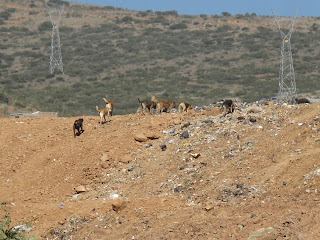
When I started to take a few photos the breeze shifted and I was molested by the smell of the dump. When I looked toward the tip I could see more dogs roaming about. I counted at least ten per pack but only managed to photo seven together at one time. I got bashful about taking photos quickly and decided to leave. As I walked away I noticed how much debris was scattered beyond the fence line. Worse than that was the shacks erected amongst the mess. To my right I saw three children laughing and playing (throwing rocks at each other) in amongst it all. They sounded happy. Before leaving I spoke to one of the boys playing - in a final attempt - to get information about the recycling. Though he couldn’t help me he did shock me worse than the dogs: he was such a nice kid, totally sweet. His input to the morning left me more unsettled than anything else. Thinking of his face I cannot help wonder what he has to do with recycling; the purpose of my trip.

As I returned to the main road I encountered my sixth lady for the morning and exchanged a warm “buen dia.” She then asked me where I came from. To say she presented as shocked would be a gross overstatement. I let her know I had come from the dump (el botadero) which was returned with a mild questioning stare. I will say this, all the people living around here are cordial (dogs excluded in this value-judgement). I gave her a wave and a hasty “caio-caio.” I should have stayed and practiced my Spanish. She wanted to chat.

So where do plastics go in Cochabamba? This I cannot answer as conclusively as I would like. I can say with some certainty that many of them get piled up in pens next to a shack that houses a ten year old boy and his family. The boy has a dirty face and his demeanour is friendly. His shack is next to a big steaming pile of refuse. I am not sure I expected to see a plastic chipper or a revolutionary recycling programme when I made this trip. Having said this I did not expect to be brought so close to the massive challenges facing a developing country. Out in the K’ara K’ara rubbish dump you can get in touch with all manner of need: educational, health, environmental, waste management, town planning, basic infrastructure (power, water), parenting, employment, animal welfare... on and on the list could go. Wondering where plastics go has led me to the sharp end of poverty in Cochabamba and thus a new set of questions. I am sure I do not need to enumerate them for you.

Tuesday, April 13, 2010

¡¡¡Yo soy materialista!!! (#1)

I like my watch because it is plain and it is functional. I bought it at Mercado Central, Sucre with Sarah. I had needed a watch for weeks. It could sound insignificant but when you travel you actually require one. Mobile phones or the Microsoft clock do not feature in the travelling life.

To get this task, which I had been avoiding, out of the way we stopped at the first stall we found. We browsed the selection. Kitsch has always been a distraction; maybe a Barney the Dinosaur watch would be a goer? In the end there were only two legitimate contenders. Both plain. I went with the flatter one. Not slender like a chicks watch, or my dad would wear, but compact (in my mind at least).

The first thing I noticed about the watch was the seconds counter takes up half of the screen. This “function” was very distracting and seemed highly impractical. A watch is to tell the hour last time I checked. But I knew we could change that; Sarah and I worked at it for hours. Unfortunately our efforts went unrewarded. The big seconds - relentlessly ticking away - were here to stay.

A couple of days later I was surprised to find that I was becoming quite affectionate toward the big numbers. Out the corner of my eye I now have a counter that cost 25 Bolivianos. Out the corner of my eye I see my life ticking by second-after-second. It is my life evaporating in a way not dissimilar to the “sands in the hour glass” as described at the start of Days of Our Lives. I am getting more than my money’s worth with this one, clearly.

Tuesday, April 6, 2010

Easter in Bolivia 2010

Samaipata

There was a slight tinge of regret about the Samaipata trip. Firstly, this is a Catholic country unlike any I have been in before. I would have loved to have stuck around and observed Cochabamba during Easter. Secondly, there were significant elections going on in Bolivia and I would have liked to have been more active in following it over the weekend. I can only say, somewhat fatuously (I guess), that this is the bane of living in a country that you are interested in.

Our plan - Sarah, Hester and I - was to head to Samaipata and do some day hiking. We were successful in this. After a 15 hour trip via Santa Cruz we spent three good days in the town and, at the expense of sounding monotonous, enjoyed every moment of it.

I went berserk with the camera and took a lot of photos. We ate at some nice places and enjoyed strolling the dusty streets in the evening while locals revelled in carnival like festivity. The popular games in Samaipata were of the gambling kind and were modest in their invention. Flipping coins onto targets. Spinning Wheel of Fortune-type arms against buffers made with metal door handles. That kind of thing.

The Bush (Central-eastnortheast Bolivia)

The highlight over the weekend was when we got to see some monkeys. I will not hold it against you if this sounds typical and therefore boring. But what made this experience so cool was the atmosphere. In this bush (Bosque Nubaldo) there are barely a handful of birds and it is very quiet in this regard.

To see the monkeys our guide, Saul, was calling the monkeys up on a hilltop. None came. Great work Saul. With some keen hearing he established that they were in a ravine just ahead of us. So we made our way down. To call the monkeys a whistle, not unlike a bird call, was used. As we descended into the bush we all began creeping. The whistle continued. Then suddenly a distant response echoed back. We all froze in our spots. Slowly but surely the monkey’s began to emerge. At first all you could hear was their cooing responses followed by silence and then the rustle of branches high above as they jockeyed for position.


After several more rustling branches, some sustained silence and flashes of tail and hind-leg they emerged in front of us. About 200 hundred metres away, high in the tree tops. Their dramatic entrance combined with their enquiring expressions (looking straight directly down at us) was a really special moment in the park. And their appearance, hoary faces and nimble bodies through the trees, being in their world as opposed to a fucking zoo. It was really great. The one on the right kind of looked like Abbath Doom Occulta from Immortal, too. Cool. Muchas gracias Saul.

Besides monkeys we saw dozens of caterpillars, multitudes of butterfly’s, spiders, “Boatman”, a giant slug, a Toucan and a “Jae” bird, fresh puma and bear prints on the trail, strange fungi, familiar ferns, and our first proper condor sighting (so immense) on the way home. An awesome day in the bush from start-to-finish.


Getting Home

It has now become very normal to get on a 12 hour bus which arrives at the destination at 3AM in the morning. This kind of thing does not suck up the same amount of psychic energy as it did three months ago, which is a big relief (this is the kind of bus ride we had to take to get home).

On the other hand the adventure of taking 10+ hour bus trips is on the wane. Not only that, the bus we were on broke down at 02:30AM in the morning. I awoke feeling nauseous and had to step out into the night to get some fresh air. I felt like vomiting but annoyingly could not. The fresh air was also icy and commonly unwelcoming at this hour. I stared gormlessly at the conductor replacing the rare-left tire and felt sorry for myself.

To balance this negative it was very nice to get into Cochabamba with house keys in pocket and know that I would have a bed and a shower and food and familiarity with next-to-no bother. Just a 10 minute taxi ride across town. This is how life is poised at the moment: domestic comfort, time and monetary flexibility to go to new places tempered with mild discomfort and the unreliability of a country that has only been to be politically and economically stable in the last twenty odd years.

Friday, March 26, 2010

Reciclaje de botellas de agua en Cochabamba

Hanging Out

When I go for my afternoon run I am distracted constantly by side alleys and roads. Usually delimited by mud brick, there is a dog and sometimes a bike from the 1960’s quietly leaning against a wall. Always there is an enigmatic air. Where do they go? Can I go down there and if I do will it lead to equally enigmatic places? When things like this strike me in “real life” (read: when I am holding down a nine-to-five) I cannot even contemplate investigating. I do not even have the time to play let alone explore. What could be more frivolous than following street after alley after street for the sake of curiosity?

Mientras tanto: En Bolivia Bevan paseos por las calles, una flâneur

Water from the tap here in Cochabamba is not fit for consumption without treatment. Day after day we are required to buy bottled water and I cannot help but think “where does all the plastic go?” I also recall Nándor Tánczos calling for people to self-regulate their purchase of water bottles back in New Zealand. His claim being that the differences between the water from the tap and that in a bottle were negligible. He also claimed that there had been an unprecedented uptake in the purchase of bottled water and, as such, there is now a whole lot more rubbish in the rubbish-tip.


Well, political views aside, what is happening with recycling in the here-and-now in a city that is addicted to bottled water? I have no idea.

Yesterday Sarah and I gathered up our four dozen empty bottles and took them to a hole in the wall on Avineda Simon Lopez where a twenty-something girl wearing a dirty leotard, arse crack and an ill fitting top took them off our hands and endeavoured to pay us five B’s for the pleasure. We declined the 5 B’s but I did ask where the bottles go next. While not 100% certain I was pretty sure she said “Nosotros tomando los botellas a K’ara K’ara.”

That I believe. But do they actually recycle these bottles at K’ara K’ara? What are they doing with them at the very notorious K’ara K’ara rubbish dump? Right now I do not live in the real world. Time or a trip to K’ara K’ara to see what’s up.

Thursday, March 18, 2010

Side Trip

Can we stay in Bolivia?

The Chile-Bolivia border must be one of the prettiest frontiers in the world. The snow capped mountains and alpine lake that creates the backdrop to the processing centre is spectacular.


We made it back from Chile with 30 day stamps on our passports. What we really wanted was a 90 day visa. This issue combined with being on a bus that was nothing short of a cocktail of bad smelling farts left us feeling frustrated. The bus picked us up from Arica at 01:30AM (only half an hour late) and brought us to Cochabamba direct. It felt like a long journey.

Now in the sobering light of “home” (Cruce Tequina) we are comfortable with approaching the appropriate people to get a visa extension. In retrospect we are thankful that we were not turned away at the Bolivian border.

Arica

Sarah and I jumped on a bus to Chile six days prior to all this and went to the sleepy surf town of Arica. We spent the week not thinking about budgets, enjoying the very excellent Arica Surf House and most importantly swimming in the ocean. The beach was not even that great but having been so far away from it in Bolivia we were excited nonetheless.


Arica is a surreal town where there are literally no clouds in the sky; this is the driest city on earth. We have all used the phrase “not a cloud in the sky” but to actually be in a place where there are literally no clouds is, quite frankly, a disturbing sight. There is something unnatural and almost sinister about this phenomenon.

All in all I did not want to leave Cochabamba because the place treats us so well. In the end I had such a great time swimming, watching small fish launch themselves out of the sea and the birds soar above the Arica cliffs, a perfect sunset every night, not to mention having the opportunity to wear a floppy, avuncular hat. It was yet another sign that Sarah and I are currently living a charmed life.

Saturday, March 6, 2010

Writing a couple of words about someone's [new] album

Sometimes it is hard not to think that music reviewing is a big load of shit. Case in point: the review I wrote on the Trans Am record Sex Change for a magazine in New Zealand. The review I wrote was tepid a best (all 120 words of it. Ha-ha). I wrote the review a long time ago. Subsequently, I have listened to the record consistently ever since. Now, today, ahora, I am not really sure of the value in my original criticism.

To contradict myself I have no desire to apologise for writing a less-than-flattering review; I do not think I necessarily disagree with what I wrote. At the same time it is hard to reconcile claiming to be indifferent about something while still listening to it regularly (i.e. gaining pleasure from the album repeatedly).


The only thing I can settle on is that you cannot listen to a record for a day, or a week, and be sure what the long term value or affect will be. Like the Mad Butcher says: the most precious gift you can give life is your own time. When you are reviewing something you have to make your mind up about something very quickly and spit out a response as rapidly as possible.

Perhaps my problem is that I have confused reviewing with criticism. The former is simply about style and estimation and as such it does not deserve a second thought once see the “your Email [to the editor] has been successfully transmitted” message displayed.

If I ever review again I am going to flip a coin on partiality and focus on style. Like a drunken joke at a party that you are not sure you meant or not.


Thursday, March 4, 2010

Give it a rest already

So as it turns out our fears about leaving the comfortable city Sucre - and travelling to the city that few gringos visit - were unfounded. In a nutshell we have been totally spoiled since we got here. At the beginning Sarah did some serious leg work and found a bunch of different places to stay. It is to her credit that we ended up with options.

In the end we went with a house in the area known as Cruce Taquiña (north-west Cochabamba; in close proximity to the Taquiña brewery). This house had been found by two Germans – Kristen and Till – who had been hunting since being robbed twice at their previous premises. Both of these guys are incredibly talented, hard working (volunteering at a local school) and good-natured. On top of all this the place is very nice and VERY affordable.


So now we are settled we have bought a bed, table and towels and established some routines around going to the produce market which is a mere 30 metres away, the kiosko that is literally across the road (supplying us with beer and wine) and the Internet cafe which is next door to the kiosko. These activities are positioned around our main endeavour which currently is, of course, learning Spanish.


Spanish is fun so far. My tutor is called Delma. She has a warm, clement proclivity and is good at encouraging me while simultaneously putting pressure on to up-my-game. The lessons are through Sustainable Bolivia which has also been a handy place to meet people. As far as we can tell SB is the social nexus for 80% of the gringos in this town. Through SB we have met a bunch of decent folk. I cannot recall the last time I made this many acquaintances and was not been apathetic about it. This Saturday will be football in the ante meridian with SB (I am hopeful that it can fill that gap the basketball used to take care of). The game will be against a team of locals.


I could go on all day about how all my needs are currently taken care of. It is enough to make anyone sick, to be honest. Being vegan in this town is great, the hills behind our home (and in fact Cochabamba) recall Kapiti Coast without the coast (i.e. are mountainous), there is excellent weather and climate, the truffi system is brilliant, Hester has arrived, La Cancha is immense and contains real-life-pickpockets. When I go for a run in the afternoon the neighbourhood is unlike anything I have seen before: dusty, cobble stoned, massive incomplete brick-houses and soupy-green swimming pools, cows walking free, children looking at me like I am an alien and men clapping me on mordantly.

It is all coming together very nicely in Cochabamba. And all this makes me wonder what is going to happen in a week when we have to renew our visas. We will be taking a trip to Chile. If this was a movie and not real life now would be the time where the nemesis/antagonist materializes in a merciless yet surreptitious way...