Friday, May 14, 2010

Palacio de los Portales

Last Saturday our day hike of Tunari fell-through for the fifth time so we headed for an estate of a now deceased mining baron. The estate known as Palacio de los Portales. This place is similar to the Castillo La Glorieta in Sucre (from same period and category of owner) which frequently receives remarks like “[this is an example] of how wealth and taste do not do not always coincide” (though our guide book did not agree with this connection).

It was another superb Cochabamba morning and the grounds were conspicuous for their well maintained, lush presentation. This is an uncommon sight in Bolivia. It was not unlike visiting a compact version of the Wellington Botanic Garden and as such it was a pleasure when we had to wait for our friend Stephanie to arrive.


When our tour started it turned out that the guide was well read. She gave us a sound and appropriately succinct tour of the main house. There is a lot to see on the property (such as contemporary sculpture and other substantial structures like an outdoor concert area and remodelled stable). To have gone through the entire estate would have been lengthy. As it happened the main house supported a story that talked about the biography of Simòn Patiño (he, nor anyone, else ever lived in this house and as such it is in pristine condition), a history of Bolivia and an explanation regarding the property’s construction and the ruthless mixture European styles.

The best part of the morning for me was spent observing a white marble statue depicting a legend related to the St Bernard of the Alps of Switzerland. I got to do this while reclining on a park bench waiting for Stephanie. A classic and popular European myth our guide later said. While sitting a bird was over head hanging out with me. He didn’t make a lot of noise though his mates in the background were trying to get his attention. He just puffed up his chest and rigidly turned his head left and right, up and down. There was a light, cool, breeze that passed between my toes. Outside the grounds cars passed by and drowned out the bird calls reminding me that I was in the middle of Cochabamba.


I liked this moment because it took me back to the days when I could walk up the road and wander around the Auckland Art Gallery in solitude (until the redevelopment at least). In this depiction the dog was bigger than the girl. He loomed, dominating her form; a very masculine image. That aside, I liked the statue because it seemed to draw together the themes of kinship with animals (or at least dogs), fighting against the elements (which works as a metaphor), the notion of us all is being inside a single - shared - environment and finally the symbolism of books.

I also liked that I spent a bit of time thinking about the statue and then, of the hundreds of statues she could have commented on, our guide choose that one to open the tour with this one. It was good to have my own reflections supplemented with some actual facts.

It strikes me as re-assuring that I am typically compromised with my description of the palace. On the one hand I find it hard not to criticize the architecture for being inelegant and on the other I have an overriding memory of enjoying European sculpture at that very site which draws on my own experience of imitating “European culture” back in New Zealand (visiting art gallery).

Overall the Palacio de los Portales was a pleasant way to spend the morning: the dozens of contemporary sculpture, grounds composed by Japanese specialists, a unique story about the long gone wealth of Bolivia and some quiet time to look at a statue. It was a happy substitute for climbing a mountain.

Tuesday, May 4, 2010

Bolivia Corazón Vegeteriano Estricto: Guide to eating vegan in Cochabamba

My friend Lauren sums up cuisine in Argentina succinctly here. After my experience in that country I had low expectations about the kind of food that would be on offer in Bolivia. Having now lived here for a period I can say without exaggeration that this is a vegan friendly country in terms of food. It is possibly easier to maintain a vegan diet here than back in New Zealand.

What follows is a somewhat dispassionate overview of what I have found so far. For non-vegans this may be a good article to read just before you hit-the-hay.


Dining

If I want to go out to eat I can go to a bunch of places. There is a vegetarian buffet on the main drag: Avienda Heroinas, fourth floor of the Dumbo’s building. The best almuerzo in town is at Gopel; a Hare Krishna place that provides a four course vegan meal/buffet for 15 bolivianos. There is a second Gopel in close proximity that also does a range of dinner meals including Chinese style dishes that use seitan. Across town (north-east) in Recoleta there is an up market Chinese place called Lai Lai’s that serves two tofu dishes (picante and normal) which are both adequate for two people per portion and always reliably prepared.

The pasta in Cochabamba is not too bad either. Most restaurants do basic plates of tomato sauce with pasta. My personal favourite is the Aglio from El Caracol; a very minimal recipe with chilli, seasoning, pasta and olive oil but cooked perfectly every time (nb. it is not easy to cook rice and pasta well at altitude).

Produce

After the disgrace of Argentina I can only describe the availability of fresh produce in Bolivia as ridiculous. In my neighbourhood of Cruce Tequina there is a market half a block away. This market is representative of all the produce markets in Bolivia.


At this small-medium sized market I can purchase carrots, spinach, white and red onions (white is more expensive in Bolivia for some reason), avocado, potatoes (literally dozens of varieties are available), chili, capsicum, pumpkin, radishes, tomatoes, cucumber, broccoli, corn, maize, and yams. In terms of fruit there is banana, apples, oranges, mandarins, mango, papaya, pineapple, grapes, peanuts, plums (sometimes), nectarines, pears, limes and grapefruit a plenty. And even when you are getting ripped off with gringo prices you still get a good deal. The best deal in my mind is with spinach and chillis; two bolivianos gives you enough for several meals. I have to note that it is a genuine pleasure to able to walk out your front door into a produce market that is so close at hand and so reasonably priced.

There are also heaps of flowers here and it is not uncommon to just pick some up on the way through. They are so accessible and affordable that it is hard not to have fresh flowers all the time in Cochabamba.


Supermarket & Kioskos

Supermarkets and kioskos are the biggest surprise of all. Both Super Hass and IC Norte are both well equipped to look after me. I would claim that they are as good as, if not better, than what we have back home in New Zealand.


In terms of protein there is carne de soya (or TVP back home) which is found everywhere and in at least three different forms. There is also a wide range of fresh seitan products made by Gouronga (available at IC Norte). In the centre of town (on Calle Sucre, a block from Plaza 14 de Septiembre) there is an unnamed health food store that makes its own tofu. For five bolivianos you get one cube of tofu ten centimetres by ten centimetres. A generous chunk. At IC Norte you can also buy Roland tofu in a can, which is a first for me, but the price is not what I would call agreeable.


There are two other very important types of soya products available in Bolivia. Both I can normally get at a kiosko and always from a supermercado: soya milk and ice cream. Nordland provides a plethora of flavours of icecream (coffee, bubblegum, lemon, vanilla, orange, coconut) and sizes (petite pots, 1 litre and 3 litre buckets). Nordland also does soya milk, and although it is competitively priced, the Soy Leche De Soya is far superior and still cheap (only three bolivianos fifty per litre). ‘Soy’ also has the charm of being wordplay on the conjugation of the verb Ser (“to be”).


As a side note all these soya products seem conspicuous to me and warrants looking into. They love meat here (especially chicken) and thus the variety of products to number of non-vegetarians is bewildering. I look forward to finding out why this is at a later stage.

Finally, there are lentejes and frijoles in galore. Supermarkets usually have a whole aisle of dried products and while they only have one type of lentil in Bolivia they have at least half a dozen different types of beans to choose from.

And so

That is it in a nutshell. While the Happy Cow will always be able to look after vegans when they are travelling the world I still had concerns before I arrived in Bolivia. I do not want to have to eat out the whole time (or even regularly). Hopefully this overview of what they have in Cochabamba will be of use to someone who is planning on swinging by Bolivia but is not confidant about their dietary needs being met.

In my opinion this is a great country to eat if you are a vegan.

Wednesday, April 28, 2010

A good week

Blurb, yo!

This week Sarah and I got the shits because I had my backpack stolen. The pack had a bunch of important stuff in it. It really challenged us. Very uncool. The twist on this minor catastrophe was that the preceding six days were some of the best ever.

Victim of crime (for the second time in Bolivia)

Sunday was a big downer. I have already written about, and experienced, the potential dangers of travelling through La Cancha but on Sunday being familiar got the best of me. Sarah, Hester and I were in a bus and I had taken a photo out the window. I had done this while we were stuck in gridlock. Looking out the window brought me to the conclusion that this would be a good opportunity to capture the spirit of the market. Hindsight now tells us that this was the antithesis of “good opportunity.”

A few minutes after taking the photo a guy reached up through the window and snatched my backpack from my lap. The window of the bus that is. I never had a chance, he was so quick. We raced off the bus and chased after him. Some people pointed directions but it was impossible. In La Cancha you are amongst the multitudes and there was no way we were going to catch him. And what if we had caught him, what were we going to do? Mercifully I had my wallet in my pocket.

La semana pasada

Besides the low moment on Sunday my week was a flood of brilliant experiences. It was a week that recalled our first seven days in South America. When we arrived in Buenos Aires everything felt worthy of commentary. I was in a perpetual state of wonder. Similarly, this week was stacked in the same kind of way.

The week started with my new Spanish teacher who is excellent, the Climate Change Conference and Eco Village (where I saw the very entertaining band Cartel Afonico). Later in the week I started watching The Wire lent to us by our friends Jason and Emily, I got to write and run every day and I started volunteering at an orphanage called Casa Cuna on Wednesday.

The weekend begun with a great night out seeing another friend (Lindsay) off then on Saturday morning I slept in and read. At midday a massive parade came down our - inconsequential - street (like a mini Oruro Carnival) and then in the afternoon I played football with the Sustainable Bolivia crew and scored a bunch of goals. Later in the evening I ate the best burritos and drank beer.


On Sunday I went to the local derby between Aurora and Wilstermann in the late afternoon. Aurora levelled the scores 2-2 in the last two seconds of the game. It was an intense ending to the game and it led to a punch-up out the front of the Stadium post-match. Having had enough drama from La Cancha earlier in the day I covered my Aurora jersey with a t-shirt to avoid any unwanted beatings; Aurora fans are outnumbered twenty-to-one.

And on it goes. I could write ten more bullet points underneath each of those moments, or (even worse) 2000 words per item. I could write 5000 word on the orphanage. The point being that it is confronting to be filled with anger (and I am angry) about having my bag stolen while (a) having such abundance in my life and/or (b) spending time with orphans who have no parents and play with broken-ass toys day after day and are happier than any adult I know. In the end I am going to assume that my anger is coming from my own stupidity (i.e. shame) so I will just have to deal with that. In the meantime I will reflect on this week past and keep it all in perspective.

Monday, April 19, 2010

Aurora Football, Cochabamba (the other team)

I finally made it to a football match in Bolivia thanks to my friends Emily and Jason (who we met back in Sucre; the second time). The game was between Cochabamba (Aurora) and Sucre (Club Universitario). Aurora are known as an underdog that represents the south of Cochabamba. The south is generally recognized as the poorer part of town. The rest of Cochabamba support Wilstermann. My previous Spanish tutor, Delma, had told me about Aurora. She said that it was very easy to go and see them practice during the week. Jason and Emily confirmed this for me on game day, too. This will be another side road, or cul-de-sac, for me to check out.

The experience overall got a strong pass mark. The perennially clear Cochabamba afternoons combined with the stadium which has the stunning backdrop of the surrounding (gargantuan) hills made for comfortable football watching.


I also got to soak up the Aurora scene pre-game because, luckily for me, Jason and Emily were running late. As my jeans stuck to my legs I glanced at the sky and thought of the team (light-blue is their colour), I observed the very modest crowd in attendance while inhaling - with pleasure – the smoke wafting over form the barbequed potatoes and felt the heat of the concrete on my elbows as I reclined and watched the fans amble. It was Sunday afternoon as it should be.


Beyond all of these things the best part of the day was that the team that I was supporting actually won. A highly uncommon experience for me. I will be transparent and acknowledge that I wanted to support Aurora for their underdog status. Now, combining that with the fact that they actually notched-one-up I am in.

¿Que color es mi sangre? Ahora, mio sangre es celeste.

Friday, April 16, 2010

Plastic bottles... where do you go?

This week I made it to the rubbish dump in search of plastic recycling. To get there Sarah (thanks to her knowledge of truffi’s) escorted me to the right neighbourhood. Well, her and the help of the person next to me on the truffi. The older Cochabambino gave me great directions and instructed the truffi driver on where to drop me off. For this I was thankful because getting to the dump did not end up being as straight forward as I would have liked. I had to hunt for a bridge to cross the river and speak with a local woman who was not convinced I really wanted to know where K’ara K’ara was. In the end this trip was experiential rather than educational in the pedagogic sense. It blended two disparate beasts: adventure and the confronting reality of poverty.


After crossing the small bridge (stolen from The Temple of Doom archives) I wandered up a peaceful hill on a winding dirt road toward (I assumed) the dump. Despite the depressed nature of the neighbourhood there was a calm here that was surprisingly comforting. Comforting until I made it half way up the hill. As I came to the fourth bend I could hear dogs barking. When I appeared around the corner a group of dogs on my right raced toward me barking and bearing their teeth while another group barked and circled to my left. When I walked on they all slowed but continued to aggress. This was the cue to shit my pants. My pace began to halt and then a lady emerged from doing her washing. The lead dog of the left pack turned its head toward her with doe-eyes. Then stopped barking. All the dogs on the left quietened and I was able to pass while the dogs on the right continued the vocal assault.

After the dogs I hardly minded the irritated expression the lady at the top of the hill gave me when I asked for directions. Unfortunately for me the dump ended being visible from where we were both standing. As I approached there was little smell coming from the dump. They must be doing something right. At the fence line I found a sign that says there is a 1000 Boliviano fine for trespassing. I would not be seeing the giant mound of rubbish up close today. Despite this, serendipitously, there were numerous pens (where I had arrived) filled with plastics. I walked about looking at the muddled structures that were strangely organized in terms of plastic categorization. In walkway amongst the pens I spoke to my third lady for the morning who could not understand a word I was saying. I can only deduce that she only spoke Quechau (a really possibility; not sarcasm about my ability to speak Spanish). Five minutes later a man and a lady were just as much help though they did speak Spanish. They suggested to me that plastics do not go anywhere. Groan, surely not, then why are ordered like this?


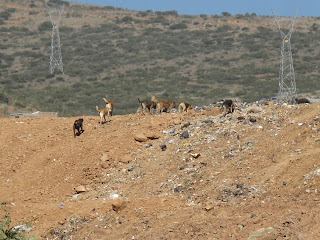
When I started to take a few photos the breeze shifted and I was molested by the smell of the dump. When I looked toward the tip I could see more dogs roaming about. I counted at least ten per pack but only managed to photo seven together at one time. I got bashful about taking photos quickly and decided to leave. As I walked away I noticed how much debris was scattered beyond the fence line. Worse than that was the shacks erected amongst the mess. To my right I saw three children laughing and playing (throwing rocks at each other) in amongst it all. They sounded happy. Before leaving I spoke to one of the boys playing - in a final attempt - to get information about the recycling. Though he couldn’t help me he did shock me worse than the dogs: he was such a nice kid, totally sweet. His input to the morning left me more unsettled than anything else. Thinking of his face I cannot help wonder what he has to do with recycling; the purpose of my trip.


As I returned to the main road I encountered my sixth lady for the morning and exchanged a warm “buen dia.” She then asked me where I came from. To say she presented as shocked would be a gross overstatement. I let her know I had come from the dump (el botadero) which was returned with a mild questioning stare. I will say this, all the people living around here are cordial (dogs excluded in this value-judgement). I gave her a wave and a hasty “caio-caio.” I should have stayed and practiced my Spanish. She wanted to chat.

So where do plastics go in Cochabamba? This I cannot answer as conclusively as I would like. I can say with some certainty that many of them get piled up in pens next to a shack that houses a ten year old boy and his family. The boy has a dirty face and his demeanour is friendly. His shack is next to a big steaming pile of refuse. I am not sure I expected to see a plastic chipper or a revolutionary recycling programme when I made this trip. Having said this I did not expect to be brought so close to the massive challenges facing a developing country. Out in the K’ara K’ara rubbish dump you can get in touch with all manner of need: educational, health, environmental, waste management, town planning, basic infrastructure (power, water), parenting, employment, animal welfare... on and on the list could go. Wondering where plastics go has led me to the sharp end of poverty in Cochabamba and thus a new set of questions. I am sure I do not need to enumerate them for you.

Tuesday, April 13, 2010

¡¡¡Yo soy materialista!!! (#1)

I like my watch because it is plain and it is functional. I bought it at Mercado Central, Sucre with Sarah. I had needed a watch for weeks. It could sound insignificant but when you travel you actually require one. Mobile phones or the Microsoft clock do not feature in the travelling life.

To get this task, which I had been avoiding, out of the way we stopped at the first stall we found. We browsed the selection. Kitsch has always been a distraction; maybe a Barney the Dinosaur watch would be a goer? In the end there were only two legitimate contenders. Both plain. I went with the flatter one. Not slender like a chicks watch, or my dad would wear, but compact (in my mind at least).

The first thing I noticed about the watch was the seconds counter takes up half of the screen. This “function” was very distracting and seemed highly impractical. A watch is to tell the hour last time I checked. But I knew we could change that; Sarah and I worked at it for hours. Unfortunately our efforts went unrewarded. The big seconds - relentlessly ticking away - were here to stay.

A couple of days later I was surprised to find that I was becoming quite affectionate toward the big numbers. Out the corner of my eye I now have a counter that cost 25 Bolivianos. Out the corner of my eye I see my life ticking by second-after-second. It is my life evaporating in a way not dissimilar to the “sands in the hour glass” as described at the start of Days of Our Lives. I am getting more than my money’s worth with this one, clearly.

Tuesday, April 6, 2010

Easter in Bolivia 2010

Samaipata

There was a slight tinge of regret about the Samaipata trip. Firstly, this is a Catholic country unlike any I have been in before. I would have loved to have stuck around and observed Cochabamba during Easter. Secondly, there were significant elections going on in Bolivia and I would have liked to have been more active in following it over the weekend. I can only say, somewhat fatuously (I guess), that this is the bane of living in a country that you are interested in.

Our plan - Sarah, Hester and I - was to head to Samaipata and do some day hiking. We were successful in this. After a 15 hour trip via Santa Cruz we spent three good days in the town and, at the expense of sounding monotonous, enjoyed every moment of it.

I went berserk with the camera and took a lot of photos. We ate at some nice places and enjoyed strolling the dusty streets in the evening while locals revelled in carnival like festivity. The popular games in Samaipata were of the gambling kind and were modest in their invention. Flipping coins onto targets. Spinning Wheel of Fortune-type arms against buffers made with metal door handles. That kind of thing.

The Bush (Central-eastnortheast Bolivia)

The highlight over the weekend was when we got to see some monkeys. I will not hold it against you if this sounds typical and therefore boring. But what made this experience so cool was the atmosphere. In this bush (Bosque Nubaldo) there are barely a handful of birds and it is very quiet in this regard.

To see the monkeys our guide, Saul, was calling the monkeys up on a hilltop. None came. Great work Saul. With some keen hearing he established that they were in a ravine just ahead of us. So we made our way down. To call the monkeys a whistle, not unlike a bird call, was used. As we descended into the bush we all began creeping. The whistle continued. Then suddenly a distant response echoed back. We all froze in our spots. Slowly but surely the monkey’s began to emerge. At first all you could hear was their cooing responses followed by silence and then the rustle of branches high above as they jockeyed for position.


After several more rustling branches, some sustained silence and flashes of tail and hind-leg they emerged in front of us. About 200 hundred metres away, high in the tree tops. Their dramatic entrance combined with their enquiring expressions (looking straight directly down at us) was a really special moment in the park. And their appearance, hoary faces and nimble bodies through the trees, being in their world as opposed to a fucking zoo. It was really great. The one on the right kind of looked like Abbath Doom Occulta from Immortal, too. Cool. Muchas gracias Saul.

Besides monkeys we saw dozens of caterpillars, multitudes of butterfly’s, spiders, “Boatman”, a giant slug, a Toucan and a “Jae” bird, fresh puma and bear prints on the trail, strange fungi, familiar ferns, and our first proper condor sighting (so immense) on the way home. An awesome day in the bush from start-to-finish.


Getting Home

It has now become very normal to get on a 12 hour bus which arrives at the destination at 3AM in the morning. This kind of thing does not suck up the same amount of psychic energy as it did three months ago, which is a big relief (this is the kind of bus ride we had to take to get home).

On the other hand the adventure of taking 10+ hour bus trips is on the wane. Not only that, the bus we were on broke down at 02:30AM in the morning. I awoke feeling nauseous and had to step out into the night to get some fresh air. I felt like vomiting but annoyingly could not. The fresh air was also icy and commonly unwelcoming at this hour. I stared gormlessly at the conductor replacing the rare-left tire and felt sorry for myself.

To balance this negative it was very nice to get into Cochabamba with house keys in pocket and know that I would have a bed and a shower and food and familiarity with next-to-no bother. Just a 10 minute taxi ride across town. This is how life is poised at the moment: domestic comfort, time and monetary flexibility to go to new places tempered with mild discomfort and the unreliability of a country that has only been to be politically and economically stable in the last twenty odd years.