Tuesday, August 10, 2010

Time to get up

It has been pretty exciting starting at Performing Life. Working with John is cool and I feel like I am using my area of expertise by writing grants and updating content on the new website. Contrary to this, as all good stories go, is that my previous schedule is incompatible.

I have exercised my remarkable intellect, yet again, and come to the conclusion that I need to change my schedule. I really want those black “X’s” on my daily checklist. From now on I will get up at 06:00AM and go for a run then study for an hour. Following that I am going to eat porridge have a shower and walk to work for 09:00AM.

I have actually already tried to do this. The truth is sleeping-in has seemed like a whole lot more fun so far. The only way to get this underway is to call-myself-out on my blog (is blog a proper-name and needs a capital?), read some science from Oprahdiluvian type websites, tell Sarah, check something T.S.Eliot said and set my alarm.

Thank you "youth culture of digital narcissism." Because of you I am pretty sure I am going to go for a run in the AM now.

Friday, August 6, 2010

The Saga of Casa Cuna

Part One: the joys of working at Casa Cuna

I have never spent a whole lot of time with children or made plans to have kids myself. Despite this I learnt at Casa Cuna that hanging out with kids was a whole lot of fun. As I developed a relationship with the orphans, or "abandonados de niños" as they are sometimes called, the smell of urine and household cleaner that greeted me when I entered Casa Cuna became the smell of play and laughter.

From my experience the kids were all friends. They got along really well. Yeah they cried but only when they fell over or took each other’s toys (e.g. normal kid stuff). A couple of them were more frangible than others but overall my perception of the children was that they were very happy. And really cute.

Ahhhh Pancho. I will never forget my first day walking upstairs and seeing you with the bathroom - door wide open - and barely balanced on the toilet bowl rim. You had gargantuan, limpid eyes and were making the most astonishing noises. How can someone be so little and create such profoundly violent flatulence? At the time I couldn’t believe it was you!

Part Two: how it functioned

Casa Cuna was founded by Doctor Maria Ferrera but the orphanage was managed fulltime (24 hours) by shifts of two teams of two nurses and during the day with Virginia (the coordinator) and her son Israel and daughters Maria and Ruth. In addition to the people there was Israel’s cat Chulo who was also an orphan found in the street. The nurses worked on rotating 24 hours shifts which would alternate 3 and 4 days per week between the two teams. Virginia worked 09:00-17:00 Monday-Saturday. I describe Virginia as strict but compassionate and the nurses as efficient and well humoured. These things together created a family atmosphere in Casa Cuna.


In terms of funding, up until the end of 2009, Casa Cuna was supported by Millennium. Unfortunately the money dried up in the States and things began to get tough at the orphanage. Amizade (a global NGO that has an office in Cochabamba) made an appeal to get more funds and wrote about it here and here. Despite this set back, while I was there, things looked good. The kids were well looked after and they got good food (they were eating a lot of vegetables, uncommon for a lot of Bolivian children). They also got a lot of attention and structure in their day.

Those of age were bundled into a car and taken to Tiquipaya for school Monday to Friday. The kids were aged one through to seven. I was told that at the age of eight they would be moved to another place, perhaps another orphanage, where they stay until they are about 16 or 17. Frustratingly no one knew where (or wanted to tell me) where this “other place” was or what it was called.

I believe that Casa Cuna got a lot of mileage out of what they had. For example, they washed/scrubbed the dirty old ripped mattresses and hanging them out to try frequently. This shows, in my opinion, their desire for hygiene as well as caring for what they have despite the destitution.

Part Three: what happened next

So what happened?

Well in a nutshell social workers form the government (Sedeges) turned up and inspected the place. The social workers were solemn bunch but everyone from Casa Cuna seemed totally relaxed an unstressed in their presence. I should note that at one point in the day Virginia asked me to not say anything bad about the orphanage. Obviously this struck me as odd. Why would I? Suspicious? Yes.

The assessment was completed and a week later there were no more kids.

I was told initially that they would be back in fifteen days. In the meantime we set about working on the house; painting, gardening, spring cleaning. I felt that it had been implied that the kids had gone on a holiday and that this was all totally normal. Then the fifteen days elapsed, then twenty and then thirty. Still no kids.

On the day I decided to call-it-quits they spilled the beans and told me that the kids had been taken away by the government due to the results of their psychological assessments and signs of abuse to the children. They also told me that they were going through the courts to defend these allegations. I have found this article which I believe is about them. In my opinion the article is "light" and quite ambiguous.

Through information acquired by a friend here in Cochabamba we also found out that an assessment had been completed by the same social workers earlier in the year. Allegedly, they had made recommendations that were not acted on by Casa Cuna and as such the kids were removed. The story of the removal sounded pretty horrible. I am not going to go into here. I will state that I never saw any abusive behaviour in my time at Casa Cuna.

Finally, it has been said that Bolivia no longer wants private orphanages. I have nothing to back this up but it does fit in with Evo’s nationalisation project and perhaps this is part of the explanation.

Part Four: goodbye

So the kids never came back, their cat Chulo died and I said goodbye. Perhaps surprisingly, I got a nice farewell and enjoyed hanging out with Virginia and her family, practicing my Spanish. But what occurred here... I will never fully know. I Emailed Amizade to get there side of the story but nothing has come of it so far.

In the last days, the house still smelling of cleaner and a faint aroma of urine, I played PS1 (NFS and Tekken) with Israel and had some amazing food cooked by Virginia. She also gave me these cool, handmade, chocolates. In spite of this it the farewell that did not quite feel right. I never got to say goodbye to the kids. To have formed a relationship with little-people and then to have them taken away... it is a bitter memory to say the least. This was also compounded by the strange approach by Casa Cuna took to talking to me about “what happened” with the removal. In retrospect it is possible that they were in shock, and angry, and as such did not trust anyone. Maybe they thought I contributed to it. Who knows.


Part Five: final contact?

A week after I left Casa Cuna they asked me to come in for a meeting. Virginia did not tell me what it was about.

As I made my way over I got a text message changing the time of the meeting so I returned home. When I returned to Casa Cuna no one was there. I left my Email address and a note in the door. No Emails have been received as of yet.

Friday, July 30, 2010

Truffi Wars

I was frustrated when I left home and could not find my usual truffi-taxi. I walked over a couple of blocks to a road that Sarah had recommended. Not a truffi in sight. "Good one Sarah, thanks for the advice," I thought. As I hiked across town I noticed that there were no buses or truffi's anywhere. Then I recalled that my new boss at Performing Life had said that there were truffi drivers smashing out windows on El Prado yesterday. My sharp intellect then put it together that there must be a strike on.


I eventually
made it up to El Prado (part of the route I was taking) and I saw the inevitable gaggle of men blocking the road. As they walked along I started to hear wolf-whistling and thought to myself "what kind of protest march is this." Subsequently, I ran up the road a bit to get a better view of proceedings. At this point the march seemed even stranger. What were these bits of wood they were carrying, what could they possibly symbolize; perhaps something Andean?

Well, I say to you, in the moment these are the things you think.

A minute later a mini-van with its truffi line number on its roof then appeared on El Prado. The men swarmed the vehicle and battered it with the sticks, some of which were five feet long. An argument then ensued and then the mob smashed out all the windows of the mini-van.The man circled in red below punctured a hole through the back window with a long staff. He seemed to be the ring leader.


As you can see the photo I took is very undramatic. A minute after it was taken a Police car arrived on the street but did not seem to stop to manage the situation. I got on my way and then realized I was in a mild shock. What the heck was I doing chasing after a group of angry unionists with bludgeoning instruments? What was I doing taking photos of them? This can only be described as bad decision making. What an idiot.

Since witnessing this protest I have checked the back story. Basically what has happened that the truffi line-110 is being challenged by other truffi drivers. Agreements on legal and illegal lines have come to an impasse in Cochabamba and as such cars (almost 100 of them) were attacked yesterday by anti line-110 group. In response to those attacks the pro line-110 people have responded with their own attacks.

Even though nothing happened to me today I have to say that this incident really brought home how quickly curiosity can bring you needlessly into harms way.

Tuesday, July 27, 2010

¡¡¡Yo soy materialista!!! (#3)

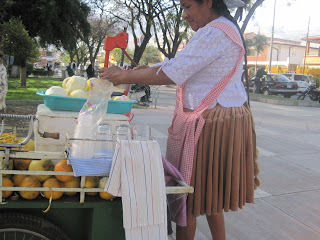
In Cochabamba there are a lot of street vendors. They sell salteña, snacks, sugar cane (out of wheel barrows), cigarettes as well as non-edible items too innumerable to list here. Probably the nicest thing in terms of street venders in Bolivia is the grapefruit/orange juice carts. These carts are on every other corner and dotted around plazas.

In terms of self-gratification there are few things as simple or as pleasurable as finishing up on a warm Cochabamba afternoon and walking through a dappled plaza to a juice lady and watching the world go by as you suck back a freshly squeezed juego de pomelo. The produce is local, you don’t have to drink out of a disposable plastic cup if you don’t want to and if it is quiet the vendor will chat to you even though your Spanish is weak.

I should note that if you ask how much for a glass you will pay BS$03.50 (NZ$00.70) or even BS$04.00 (NZ$00.80) if you are shy and unlucky. When you figure out what is going on BS$03.00 (NZ$00.60) is the price. I recommend you never ask for cost on this one, just hand over the money*.

* Prices in Bolivia for everything are negotiable most of the time (though not in the severe entrepreneurial spirit found in Asia). For example with a taxi the time of the day, how many people and the quality of the taxi will all effect the price of the ride. There are no meters in taxis and “time spent” is not often a variable a driver will consider. Before you get in a taxi you always discuss price through the window. The same thing goes when you are buying fruit and veg in a mercado. This seems to be a distinct difference when dealing with juice carts.

Wednesday, July 14, 2010

Did I mention I was a middle-manager?

It would be a lie if I tried to give you a sound reason for this exercise. I cannot really answer it. All I can say, for context, was that three months ago I began tracking the top six activities that I thought I should complete everyday. If I did anyone of these activities for more than one hour on a given day (excluding making a diary entry) I would get an ´X´ for completed on my daily tracker.

You could argue that the Rule of One Hour is a weak measure. How does doing any of these things for at least one hour actually add up to or even produce a desired result? Well, feel free to reflect on that one yourself. When I started to question the validity in the Rule of One Hour the only conclusion I could make was that this has gone far enough, I am incapable of refining this process and its feeble methodology any further.

Now three months deep I have got some data and I have got graphs.


Graph One

The first graph I made was a bust. Or as Sarah said, "A waste of time." I wanted to see if there was a general pattern to my month; was I doing more/less/the same thing during the first/second/third/forth week of a month?

The below information reflects all activities completed every day over the course of April, May and June. There appears to be little or no trend. The only thing I could establish from this information was that May and June started well and trended down while April started low and finished more productively.

Graph Two

The second thing I wanted to establish was which activity was favoured over others. Below we can see that reading has taken the lead by a country mile. Not surprisingly the next highest activity was completing a diary entry (i.e. is not subject to the Rule of One Hour and therefore is a less onerous task).

All other activities have been completed consistently though with less frequency. It should be noted that volunteering started half way through April and D.W.E. did not begin until June. It is also notable that May was conspicuously less productive though the trend is generally the same. The lack of productivity in May relates to the time taken out to travel to La Paz to see Hester off.


Graph Three

My favourite discovery so far is through the Overall Productivity Per Day of the week graph. With the exception of May which (as explained above) has been an irregular month April and June clearly show us that there may be some truth in that myth about the middle of the week. As far as Executives are concerned the best day is Tuesday.

I must say that while I am not working nine-to-five I am happily amused with the approximate correlation. The other thing this graph reflects is that there are no "dead" days. When it comes to picking my own schedule and choice of daily activities it appears that any-day and every-day is a good time to being "working" on something; TGIF does not exist in this current lifestyle.

Graph Four

The fourth graph is nice and simple. May is shown clearly as a weak month while April and June reflect that I am consistant with struggling to obtain a perfect score of 186/186 (April/May) and 217/217 (June; +31 for actovoty of D.W.E.) with April being my first - and by far - best month overall.

In terms of percentages that means that in April I completed 158/170 (92.94%), May 106/170 (62.35%) and 170/217 (78.34%) in June.


Conlcusion

It is clear that I have found it diffcult to stay motivated to complete all acitivites everyday.
If you were my boss, and given that I have choosen all these activites myself, I think it would be fair to challenge me on this. Why should I be kept on if I am not completing jobs as agreed? Has an agreement not been made here?

Motivationally it should be said that there has been "good", clear, performance in some areas (reading and writing my diary). To develop in the next quarter there is much improvement needed in the areas of studying spanish, volunteering, exercising, D.W.E. and writing.


More generally it appears that - despite having an alternative lifestlye currently - there is still a trend through the middle-days of the week where my performce peaks like any other middleclass person. Contrary to this is the fact that I will still produce on Saturdays and Sundays when Monday-Friday type activities are usually in hiatus in a standard nine-to-five type lifestyle.


Wednesday, July 7, 2010

Weekend trip to Villa Tunari: Day Two

On our second day we made our way to La Jungla which is a rope swing park in a jungle setting. As Stephanie pointed out it was not unlike the world created in Hook. The only difference being that those Hollywood sets would have had building standards to adhere to. But this is Bolivia after all. There were nails jutting out of boards, ladders on awkward (read: dangerous) angles, platforms three levels up in the trees with questionable integrity and railings that seemed to be there for aesthetic purpose rather than function. The whole time I couldn’t help think of the Cave Creek Disaster.

I probably would not use this facility again but while I was there was no way I could chicken-out. We went around the sky walks, observed all the chicks with their mothers scratching around in the dirt, tried a small swing and a flying-fox that splattered Stephanie with dirty grease then made our way over to their biggest adventure-swing that is about eighteen metres high.

Sarah had no qualms about doing this meaning that my masculinity would be on the line if I did not go myself. After watching half a dozen Bolivians successfully go Sarah and I got our turn. Four stories up on the worst possible platform construction we stoically threw ourselves off the side and had a great time. But there is no way that this thing will not be responsible for a fatality one day. The harness looks about thirty years old and is perishing in places, the carabiner screw-lock was missing, the wire was tied to a branch that could only be about a foot and a half wide and the ties on the wire appeared fastened in an ad-hoc manner rather than with industrial clamping and auxiliary attachments.

The best part for me was the “loading dock” which required you to have the swing lifted over your body. This process turned you, essentially, into a human slingshot. The only thing stopping you from going over the side while the guide fastened you in was a piece of wood that your thighs pressed against. Getting the swing over my head was especially awkward as they are not used to having people of my height on this ride. The design was so poor I almost wished the platform was twenty-eight metres high so that when I went tumbling to my death the fall would be fatal instead of merely crippling.

All in all a fun day. But with an unnecessary air of danger that I do not care to repeat. You can watch me screaming like a little girl below.

Weekend trip to Villa Tunari: Day One

Sarah, Stephanie and I headed to Villa Tunari last weekend past. As per usual we had the Bolivian charm of travelling over a relatively short distance to find ourselves in a completely new climate. Villa Tunari is a classically hot, humid and sticky unlike Cochabamba which is generally warm and dry. My Spanish tutor expressed sadness about this place as it “used to be a paradise” but is now (besides being a tourist town) a major site for narco-trafficking and deforestation. And indeed, we saw a lot of logging trucks and we had to wait narco-screening checkpoints to get in and out of the town centre.

We arrived at about 21:00 on Friday night and stayed at The Mirador Hostel which greeted us with a dark loose-metal driveway (though only about thirty metres long) and dog that bolted out of the shadows to bark at us and proceeded to bite Sarah’s bag which was hanging from her side. Have I mentioned the dogs in Bolivia?

On the first day we changed hostels then, conceding defeat, spent the morning watching the Germany-Argentina match instead of getting out and about. Once we got that out of the way we headed to Parque Machia which is an animal refuge. Overall its facilities were not outstanding (e.g. viewing platforms were shoddily put together and monkeys were able to chew on or eat rubbish that was still discarded by patrons). Besides this the park was pretty cool.

There about 400 monkeys in the park (Capuchins, Spiders) as well as pumas and coati. On our way back from the emasculated El Ensueno waterfall we got to see one of the refuges pumas on the track being taken for a walk by an Australian and French volunteer. The puma was actually sleeping in the middle of the path so we had to stop and wait before we were able to pass. This worked in to our benefit because we got to chat with the volunteers and observe the cat which had its legs damaged ten years earlier by the previous owner (so that it could not run [away]).

Before we headed to the waterfall we spent time observing the monkeys. While the viewing lacked the drama of our Samaipata experience it was still a thrill to walk around and be able to see something going on in every other tree. There must have been about three-dozen monkeys in the first group we saw. The whole time they were throwing themselves around wrestling with each other on the ground and flying around from branch to branch only a meter or two away from us.

I may return here. To volunteer you have to stay a minimum of fifteen days at a cost of US$150 per fortnight. It would be great to hang in the jungle with some animals for a couple for weeks.